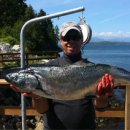
Sockeye salmon are renowned for their crimson red flesh, rich omega three content, and their long migration back to their natal creeks, streams and rivers. They are also the bright red salmon that thousands of tourists travel to see in their spawning grounds during the Fall in a variety of creeks and streams in British Columbia.
There are many large wild Sockeye fisheries in North America. Bristol Bay in Alaska is known for being the largest wild Sockeye fishery. In British Columbia the Fraser River has runs that vary from year to year. The Fraser River has had returning Sockeye runs of twenty-five to thirty million salmon. The 2026 returning Sockeye run to the Fraser is expected to be of a high number. Port Alberni located on Vancouver Island, British Columbia boasts a Sockeye run to the Somass-Stamp River system.
Returns are not like those of the Fraser River but runs can exceed one million pieces with average years exceeding six hundred to eight hundred thousand returning salmon. These Sockeye return to the river system and sit in two very large lakes (Sproat and Great Central) during the summer months in deep water before entering many streams and creeks that fill with heavy autumn rainfall.

Sockeye normally have a four-year cycle. Females will lay two to five thousand eggs in a nest called "redds" dug into the gravel of fresh water streams or lakes. The eggs incubate over the winter and in late winter or early spring they hatch but remain in the gravel till mid spring. These immature Sockeye known as Alevas have an attached yolk sac that they feed off of until they swim out of the gravel beds and migrate usually to fresh water lakes. When this occurs the Sockeye salmon are now termed "fry" and feed off of tiny aquatic insects.
Sockeye are known to remain in a fresh-water lakes for up to a year or two before swimming out to the ocean and are known as "smolts". As smolts headed to the Pacific Ocean, Sockeye go through a transformation called smoltification which enables their bodies to adapt to salt water. Sockeye will grow into adults and most often as a three or four-year old weighing from four to eight pounds will navigate back to the exact stream they were born in using the earth's magnetic field. The life cycle again will begin as male and female adult Sockeye turn a marvelous red color with their life ending after their fertilization process (spawn) in their home stream.

Once only thought of as a prime commercial salmon, Sockeye have become a very popular sport fish. Each year runs of Sockeye coming from somewhere in the North Pacific Ocean swim to the waters of Barkley Sound, make their way to the Alberni Inlet, and then into the Somass-Stamp River system. From the river the Sockeye enter either Sproat or Great Central Lake where they sit until the fall.
There is something very special about a June or early July summer morning in the Alberni Inlet when the Sockeye have arrived. The Alberni Inlet becomes alive as navigation lights flicker across the calm water as anglers head out searching for schools of chrome-bright salmon. The inlet which has been quiet for months has the hum of motors, downriggers, and the scream of the odd reel.

Sockeye are not like Chinook or Coho. They are sleek, fast and often unpredictable. Trolling for then in the Alberni Inlet has become one of Vancouver Island's most exciting summer sport fisheries. Once in the Inlet they are headed to the Somass-Stamp river system. Form mid-June into very late July the Alberni Inlet becomes a migration highway filled with schools of fresh ocean Sockeye.
Sockeye have large penetrating eyes, forest green backs, and bright silver bellies. The gums are white or pale and they do not have teeth. Sockeye are unlike Chinook and Coho which feed on bait fish. Sockeye while in the ocean feed on plankton which gives their flesh the beautiful bright red or orange color. Feeding mainly on plankton means trolling requires a different approach.
Success depends on precision and presentation of lures. Most anglers will search for schools of fish on the sonar. Sockeye will travel in very tight groups and in the early part of the season can be found in thirty-five to fifty feet of water. By mid and into late July as the inlet water warms Sockeye can be found in seventy-five to one hundred feet of water.

Sockeye fishing is very environmental. When the water in the inlet and river system warms to seventeen or eighteen degrees Celsius the migration of the salmon slows down and they begin to school in large numbers in the Alberni Inlet. The big groups of schools begin to form in many locations from the Alberni Harbour to approximately ten miles down the inlet to Franklin River and Nahmint Bay.
With the large school's anglers trolling have a wonderful sport fishing opportunity as many of these fish will come after the presentation of mini plankton type lures. The most popular areas in the Alberni Inlet for Sockeye are Lone Tree Point, Cous Creek, China Creek, Leaning Tree, the Slide, Narrows, and the Nahmint-Franklin-Ten Mile Point area.

Sockeye are best fished on a slow troll with a variety of hot-spot flashers in green, purple, and green-plaid. Some West Coast flashers in green, blue, or black are very good as well. Behind the flasher is a mp or mini plankton hoochie. The best mini plankton hoochies are colored pink and blue or pink and blank. An mp 15 or bubblegum mini plankton is also a very good choice. Leader length can vary in accordance to trolling speed which is often 1.7 to 1.9 mph. Leaders may vary from sixteen inches to twenty-five inches or more for some anglers.
Sockeye are attracted to color. Fishing with eight flashers behind the boat is not uncommon for many anglers. The eight flashers account for four "dummy" flashers and four flashers with lures. Downriggers are of course essential with staggering the various flashers with and without hoochies at different depths to cover more water until a productive pattern develops. All of the gear including the "dummy" flashers should be tight to the back of the boat. Ideally five to six feet is perfect and the flashers can be staggered twelve to fifteen feet apart. Watching the tip of the rods is of importance as some of the Sockeye bites can be surprisingly subtle.